
For most of the last decade, surgical steel and titanium have had the piercing category pretty much to themselves. Steel – because it’s affordable and every studio stocks it, titanium because it’s what any reputable piercer insists on for anything new. Neither of those things is changing. What has changed is what happens after the piercing heals, and that’s the shift we’ve been watching from the supply side over the past couple of years. If you’ve placed a production order with us recently, or simply kept an eye on your own body jewellery sales, you may already have noticed it: 14K gold and sterling silver are steadily working their way into territory that used to belong entirely to steel and titanium.
We think one trend in particular is behind it: Earscaping. As customers move from getting a single piercing to styling out a whole curated ear, they start thinking about their jewellery the way they’d think about a stack of rings. Colour, contrast, and how pieces sit next to one another matters as much as the individual piece. That’s a genuinely different buying habit to the traditional “one stud” piercing purchase, and it’s opening up a real opportunity for retailers willing to diversify their range beyond the usual steel-and-titanium default.
For UK retailers, this is a chance to widen the assortment and lift average order value – provided it’s built around the right materials. That’s really what the rest of this guide is about.
Understanding the Earscaping Trend
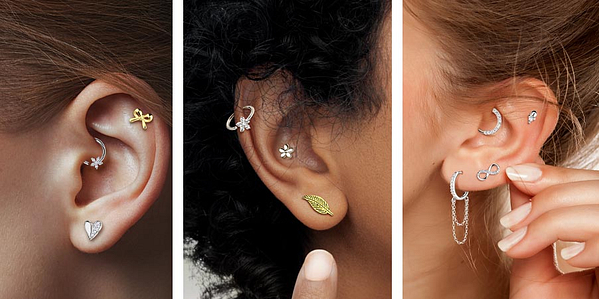
The term gets thrown around loosely, so it’s worth being accurate about where it actually comes from. Maria Tash opened her first piercing studio in Manhattan’s East Village back in 1993, and she’s the person most credited with treating a pierced ear as a genuine styling canvas rather than a single hole with a stud in it. What’s less commonly known is that the phrase “curated ear” itself didn’t actually surface until around 2015/2016, by Tash’s own account – the behaviour existed before the label did. “Earscaping” arrived a little later, popularised by newer piercing-led retailers, but it describes essentially the same thing: building a considered, coordinated jewellery collection across multiple piercings rather than buying one item at a time.
Whichever term you use, the commercial behaviour is identical, and it’s had a serious push in the last few years from Korean drama styling, TikTok and Instagram content.
What makes this genuinely different from a typical jewellery purchase is that it’s not a single-item sale. A customer building an “earscape” is usually buying five or six pieces at once (and sometimes more!) in materials and finishes chosen to sit together. For a retailer, that’s the whole opportunity in one sentence: this is a category where basket size does the heavy lifting, not per-unit margin.
Why Labrets Continue to Drive Growth
Seasonal, statement-led jewellery has its place, but it behaves like most fashion: a spike, then a fade. Earscaping runs on a completely different rhythm. It’s built on everyday wear and constant small additions. A customer might buy a labret this month, a hoop the next, and a stud pack the month after that, refining the look rather than completing it in one purchase.
That kind of repeat, incremental buying is exactly what’s pulling 14K gold into the category. A customer buying a statement piece for a single occasion doesn’t need it to last in the same way. An earscaping customer is wearing these pieces daily, for months or years, so material actually matters to them, provided the price stays low enough that adding “just one more piece” doesn’t feel like a big decision.
Why 14K Gold Is Becoming the Preferred Gold Option for Labrets
This isn’t really a fashion decision, if we’re honest, it’s a materials one. The Association of Professional Piercers, whose guidance most reputable UK studios follow even though it’s a US-based body, sets 14K as the minimum acceptable gold purity for a fresh piercing. There’s a practical reason behind that, not an arbitrary one.
Higher-karat gold is, counterintuitively, the worse choice for anything worn daily in a piercing. As purity increases, the proportion of alloy decreases. More gold content means a softer piece. This is fine for a ring taken off every night, less fine for a stud living permanently in cartilage that gets knocked, slept on, and caught on hair and hoods. 14K sits at the point where the metal is durable enough to survive daily wear without bending or loosening a setting, but still recognisably gold rather than something that reads as costume jewellery. For retailers, that combination, premium enough to justify a decent margin, durable enough that it doesn’t come back as a return, is really the whole appeal.
Our own 14K gold labret range is manufactured to REACH standards, which matters more in this category than in most others, given how much of it sits in direct, prolonged skin contact.
The UK’s Preferred Metals for Ear Labrets
Steel still dominates by volume, and that isn’t going to shift any time soon. It’s affordable, widely accepted, and the safe option most piercers recommend for a first piercing. But the diversification happening around it is real, and worth breaking down properly:
1. Titanium
Remains the workhorse of the category. It’s affordable, genuinely biocompatible, and it’s what almost every professional piercer recommends for anything fresh. Retailers stock it because customers trust it, and because it rarely comes back with a complaint.
2. 14K Gold
The clearest premium alternative right now. Price keeps it behind titanium on volume, but of the three, it’s the one growing fastest in relative terms. The contrast a warm gold tone creates against steel and silver pieces is exactly what earscaping customers are looking for when they’re building out a look.
3. Sterling Silver
The outlier of the three, and arguably the most interesting from a wholesale perspective, because it’s occupying a slightly different niche entirely. It’s less commonly used for anything fresh, but it’s finding real traction among fashion-led customers building out healed piercings who want more colour variety in their collection than titanium and steel alone can offer.
Sustainability and Ethical Sourcing Matter More Than Ever
Regardless of which of these three metals a customer ends up choosing, where the piece was actually made has become a genuine part of the buying decision, not just a line on a compliance form. We hear this from retailers directly: customers ask, and increasingly, buyers ask before they even place the order.
It’s part of why we manufacture through our own audited factory rather than a supply chain we don’t control. It means we can actually answer the sourcing question honestly, rather than passing along whatever we’ve been told.
Must-Have Designs That Pair with Any Earscaping Style
The range driving most of the growth we’ve described above sits across three collections, and we’ve built each one slightly differently on purpose. They’re designed to work as a set rather than as three unrelated product lines, because that’s genuinely how customers are buying them. If you’re putting together a beginner’s range for earscaping, our honest recommendation would be to stock a bit of all three rather than betting heavily on just one.

Our 14K Gold Labrets Collection
Our wholesale 14K gold labrets are built specifically for cartilage piercings and the kind of curated ear looks retailers are increasingly asking us to support. A few things worth knowing:
- Designed specifically for ear cartilage placements
- Built with earscaping collections in mind, rather than as a standalone product
- Available in a warm yellow gold finish that reads as genuine contrast next to titanium and silver pieces
- Set with AAAA-grade cubic zirconia
- Internally threaded backs, a more secure, more comfortable fit than an externally threaded post, and the standard most piercers now expect
If you’re building sets or multi-piece packs for coordinated ear jewellery, this is usually the piece that adds the premium positioning to the range.
Our Titanium Labrets Collection
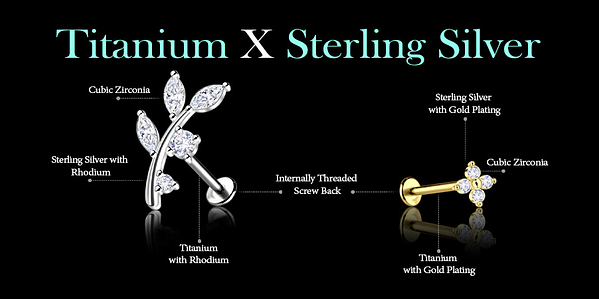
It’s worth being upfront with customers that this one is actually a mixed-metal piece, not pure titanium. Our wholesale titanium labrets combine a titanium post and internally threaded screw-back mechanism with sterling silver detailing on the visible design. It’s a genuinely useful hybrid: titanium’s piercing-safe performance where it matters (the part that actually sits in the piercing), and sterling silver’s look where it’s seen. This mix helps keep things safe and affordable.
Our Sterling Silver Helix Hoops Collection
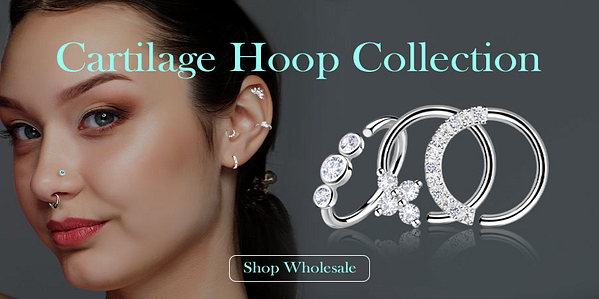
Sterling silver is still the newest of the three in this category, but it’s the one we’re fielding the most enquiries about right now. Our wholesale sterling silver helix hoops work well within earscaping sets mainly because of colour. A bright, cool-toned silver sits well against most skin tones and slots easily into combinations built around other silver or white-metal pieces.
- Bright, polished silver finish
- Works across a wide range of skin tones
- Simple enough to mix into almost any curated combination
- Secure fit across different cartilage placements
If you’re looking to add more range beyond the traditional piercing metals, this is probably the easiest starting point.
Final Thoughts
Steel and titanium aren’t going anywhere, and nor should they, they’re still doing the bulk of the volume in this category and will keep doing so. But the growth sitting around them, in 14K gold and sterling silver, is real, and it’s being driven by a genuine change in how customers buy: not one piece, but a whole considered collection built up gradually over time.
From where we sit as a manufacturer, the takeaway for retailers is straightforward. Earscaping customers keep coming back. A range that only covers steel and titanium leaves the coordinated, repeat side of that customer’s basket entirely on the table. Add 14K gold and sterling silver into the mix, and the same customer starts shopping with you for their entire ear, not just their first piercing.
If you want to see the full range mentioned above, our wholesale body jewellery collection is where all three sit together, alongside nose studs, septum clips, and the rest of the piercing range.
And if you’ve got a design in mind that doesn’t exist in any catalogue yet, e.g. your own labret shape/a specific stone setting, that’s exactly the kind of thing our design and production team can take on. We’ll work from a sketch, a reference image, or just a clear brief, and develop it into a piece manufactured exclusively for your business. You can find out more about how that process works on our production orders page, or just get in touch directly and we’ll talk you through it.